
OnlyFans ranking cards are price references, and this article shows how to use them when ten dollars is the entire monthly spend. The method below treats each card field as a decision input, compares one paid subscription against several free pages, and finishes with a short routine you can repeat every month. BestOnlyFans cards are used here only as a structured price reference, not as a recommendation. BestOnlyFans refreshes its rankings every month.
Any page that cannot be evaluated inside that cap drops out of consideration, which removes most of the noise before you open a profile. A budget this size makes mistakes cheap but not free, so the goal is to avoid wasted months rather than chase maximum value.

Ten Dollars as a Hard Monthly Constraint
When the ceiling is ten dollars, a five-dollar subscription consumes half the budget, and a ten-dollar one consumes all of it.
Fixed budgets also remove comparison paralysis. A page either fits the cap with room left for nothing else, fits it exactly, or does not fit at all.
Subscriptions renew automatically, so a page that was affordable in a light month can become an obligation in a heavy one.
A practical tip: keep the ten dollars in a separate payment method or a written note. If the cap exists only in your head, it stops being a cap the first time a promotional offer looks attractive.
One clarification matters early. Promotional first months can sit below the paid minimum, for example a three-dollar first month. That is a discount on an introductory period, not a base price, and the base price returns at renewal.
What Small-Budget Subscribers Need From a Card
The relevant fields are those that change a decision rather than describe a page in general terms.
- Base subscription price: the renewal figure, not the promotional one, because that is what repeats each month.
- Page type: a paid page charges up front, while a free page sets the price to $0 and earns through messages and tips.
- Posting rhythm: how often new content appears, since a quiet paid page is the weakest use of the cap.
- PPV presence: whether locked messages are part of the normal pattern, because those sit outside the subscription price.
- Last verified date: an old price entry may no longer match what the checkout screen charges.
Two of these deserve extra weight. Page type determines whether the ten dollars buys access or only unlocks a conversation, and the base price determines whether the page renews comfortably next month.

The platform takes a 20% fee on everything, and the creator keeps 80%. That split applies to subscriptions, tips, and unlocked messages alike, which means the same ten dollars reaches a creator differently depending on how you spend it.
For credibility on structure: BestOnlyFans cards aggregate publicly visible price fields, and the ranking order is a sorting convenience rather than a quality verdict.
One Paid Page Versus Several Free Pages
The same amount spread across free pages buys no access at all, only the ability to spend further.
| Structure | Monthly Cost | Extra Costs Possible |
|---|---|---|
| One paid page at $9.99 | $9.99 renewing | PPV messages and tips, optional |
| One paid page at $4.99 | $4.99 renewing | PPV messages and tips, with roughly five dollars left in the cap |
| Three to five free pages | $0 renewing | PPV unlocks up to $50, paid chat commonly $3-$5 per message, tips |
The table makes the tradeoff concrete. Free pages consume nothing at signup and then ask repeatedly, which is a harder pattern to manage on a fixed budget.

As more pages launched, competition for attention increased, and free access with paid extras became a common way to convert casual visitors into paying ones.
Reading a Card Before Committing the Ten
A card read should take two minutes and end in a yes, a no, or a wait.
| Card Field | What It Tells You | Decision It Informs |
|---|---|---|
| Base subscription price | What renews each month | Whether the page fits the ten-dollar cap at all |
| Page type | Whether access is bought or earned | Whether the ten buys content or only contact |
| Promotional first month | Whether a discount applies to month one | Whether to start now or wait for the base price |
| PPV frequency | How often locked messages appear | Whether the cap can survive the month |
| Last verified date | How current the price entry is | Whether to trust the card or check checkout |
Most paid pages cluster between $4.99 and $15, with averages around $5 to $10. That range sits almost perfectly against a ten-dollar cap, which is why the ceiling works as a filter rather than a restriction.
One pricing behavior belongs in the read. When a creator raises the price, auto-renew stops, and existing access lasts until the paid period ends. A price change is not an immediate charge, so a card refresh is worth checking before renewal month.
Where PPV and Chat Compete With the Cap
On a free page the subscription costs nothing, so the cap is untouched at signup. That is the appeal and the risk: the ten dollars remains available, which means it can be spent many times over in small increments.
- PPV messages: unlock prices run up to $50, so a single unlock can exceed the entire monthly cap.
- Paid chat: commonly $3-$5 per message, meaning two or three exchanges can consume the month.
- Tips: can reach $100, and they are voluntary, which makes them easy to underestimate.
- Stacking: following several free pages multiplies the number of prompts you receive without multiplying the budget.
The practical consequence is that free pages require a spending rule, not just a follow decision. Recognizing phishing style messages that imitate payment requests is part of the same discipline, since a rushed unlock is exactly the moment judgment slips.

Auto-renew can be switched off at any point, and access continues until the paid period ends, which means a page can be dropped without losing the remainder of what you paid for.
A Short Decision Routine for the Month
The routine is ordered so that the cheapest options are eliminated before any money moves.
- Write the cap down as ten dollars and confirm nothing else is owed this month.
- Read three cards and record only the base price and page type for each.
- Remove any page whose base price leaves no room for a second month at the same level.
- For remaining paid pages, check whether a promotional first month applies and note the renewal price separately.
- For free pages, estimate a plausible PPV and chat total for one month before following.
- Choose one structure: a single paid subscription, or free pages with a fixed unlock allowance.
- Set a reminder for two days before renewal to confirm the charge matches the card.
Step three is the one people skip. A page that fits this month but not next month creates a decision under pressure, and pressure is where budgets break.
Readers comparing creator pages across categories sometimes rely on a bestonlyfans influencer list to widen the candidate set before applying the cap. That is a reasonable use of a ranking page as a starting point, provided the ten-dollar filter is applied afterward.

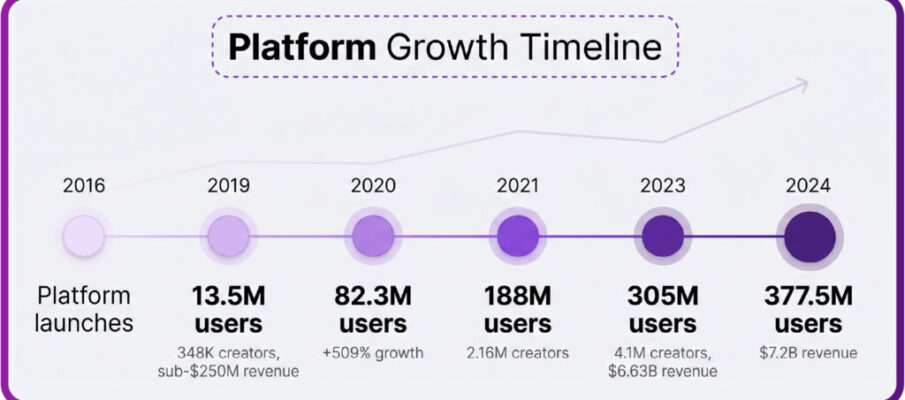
The growth timeline shows how quickly the platform expanded from its launch through the mid-2020s. That expansion is the reason ranking pages exist at all: OnlyFans has no built-in discovery feed or directory, so third-party sorting fills a gap the platform itself does not.
Signals You Should Not Spend the Ten
The signals below are specific enough to act on rather than vague caution.
- The card’s base price and the checkout screen disagree, which means one of them is stale.
- The last verified date is old and the page has not posted since.
- Every card in the shortlist sits at the top of the paid range with no promotional month.
- The page is free and the PPV pattern is dense enough that ten dollars would cover a single week.
- You already spent part of the cap elsewhere and cannot cover a renewal.
- Payment requests arrive outside the platform’s normal checkout flow.
Unspent money rolls into the next month and increases the options available, which is the opposite of what happens when a renewal you cannot afford locks up the cap.

Turning on two-step authentication protects the account that holds your payment details, and it costs nothing from the monthly cap. A card verification hold of $0.10 may also appear when a payment method is added, and it is refunded within days.
FAQ
Is a ten-dollar monthly budget realistic on OnlyFans?
Yes. Most paid pages cluster between $5 and $10, and the typical range runs from $4.99 to $15. A ten-dollar cap covers a single paid subscription comfortably and leaves nothing for extras. The cap is only unrealistic if it is expected to cover both a subscription and regular PPV unlocks.
- A single paid page near the low end leaves a few dollars of room.
- A page at the top of the typical range consumes the cap entirely.
- Free pages consume nothing at signup but invite further spending.
Should I spend the ten on one page or split it?
Splitting across free pages keeps the subscription cost at $0 but leaves the ten exposed to PPV messages and paid chat, which are harder to forecast. If you split, set the ten as a single unlock allowance and stop when it is used.
What is the lowest paid subscription price?
The paid subscription range runs from $4.99 at the minimum to $49.99 at the maximum. Nothing below $4.99 is a valid base price. A lower figure at checkout is a promotional first month applied to an introductory period, and the base price returns at renewal.
Can a promotional first month be under $4.99?
When a card shows a promotional figure, record the renewal price separately, because that is the number the ten-dollar cap has to absorb next month.